WhatsNew
Draft Bill to revise part of the Nippon Telegraph and Telephone Corporation Law
March, 1997
Ministry of Posts and Telecommunications
|
To implement restructuring of Nippon Telegraph and Telephone Corporation(NTT)
and allow it to enter the business of international communications
services, aiming to promote fair and effective competition in Japan's
telecommunications market and to actively respond to the globalization
of the info-communications business.
กก
(1) Restructuring of NTT
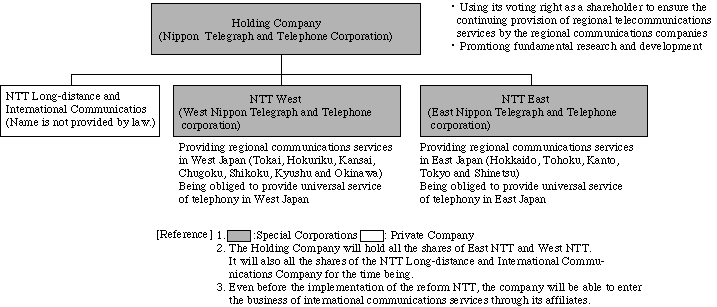
 NTT will be restructured into one long-distance communications company and
two regional communications companies, under a purely holding company
which will not be involved in communications business operations.
NTT will be restructured into one long-distance communications company and
two regional communications companies, under a purely holding company
which will not be involved in communications business operations.
 The holding company (Nippon Telegraph and Telephone Corporation)
will be a
special corporation to hold all the shares of the two regional companies,
and it will use its voting right as a shareholder to ensure
the continuing provision of regional telecommunications services
by the regional communications companies. The holding company will
also promote fundamental research and development(R&D).
The holding company (Nippon Telegraph and Telephone Corporation)
will be a
special corporation to hold all the shares of the two regional companies,
and it will use its voting right as a shareholder to ensure
the continuing provision of regional telecommunications services
by the regional communications companies. The holding company will
also promote fundamental research and development(R&D).
 The regional communications companies (East NTT and West NTT) will be special
corporations to provide regional communications services, and each
will be obliged to provide a universal service of telephony in
its business area.
The regional communications companies (East NTT and West NTT) will be special
corporations to provide regional communications services, and each
will be obliged to provide a universal service of telephony in
its business area.
 The long-distance
company will be a private company and will be able to enter
the business of international communications services. For the
time being, all the shares of the long-distance communications company
will be held by the holding company.
The long-distance
company will be a private company and will be able to enter
the business of international communications services. For the
time being, all the shares of the long-distance communications company
will be held by the holding company.
 The holding
company and the regional communications companies will be basically
regulated as special corporations like the present NTT, but will
be less regulated regarding the following points:
The holding
company and the regional communications companies will be basically
regulated as special corporations like the present NTT, but will
be less regulated regarding the following points:
- The regional
communications companies will not be regulated concerning
the appointment and discharging of their executives or concerning
the distribution of their profits;
- The holding
company and the regional communications companies will not
be regulated concerning their incidental businesses. (Currently
NTT must submit a notification in advance of starting such businesses.)
(2) NTT's entry into the business of international communications services
Even before the implementation of the reform of NTT, the company will be able
to enter the business of international communications services through
its affiliates.
(3) The fundamental principles of the reform
The Minister of Posts and Telecommunications will determine the fundamental
principles of the reform concerning the transfer of each business and
their necessary rights and duties.
(4) The reform plan
According to the fundamental
principles of the reform mentioned above, NTT will
compile a plan for the transfer of each business and the undertaking
of necessary rights and duties which incorporates the fundamental
principles mentioned in (3) above, and submit it to the Minister
of Posts and Telecommunications for approval.
(5) Special tax concessions
Special tax concessions will be made as follows.
- East NTT will be permitted to transfer money to West NTT and such money will
be regarded as an expense of East NTT.
- Concessions for capital gain tax, etc. will be provided.
(6) The holding company system
The establishment of holding companies in Japan is permitted under the revised
Anti-Monopoly Law which was already submitted to the or dinary session
of the Diet now taking place.
This law will be implemented within two and a half years from the date of promulgation.
(The date will be provided by the government ordinance.)
However, the provisions concerning procedures to establish new companies
will be implemented as soon as the law is promulgated.