

- TOP
- >Global Strategy Bureau(GSB)

Promoting research, development and standardization in the field of information and communications technology
It is important to strive to create new value by improving the efficiency of and optimizing social systems in a wide-range of fields through the use of ICT. This is designed to accommodate fierce international competition and aim for sustainable economic growth as Japan is faced with a super-aging society. Therefore, the MIC and the National Institute of Information and Communications Technology (NICT) promote research and development, societal verification, and international standardization for the ICT sector.
For this, the MIC and NICT are promoting research, development, and verification on a variety of different technologies. These include technologies for a shared infrastructure for the Internet of Things (IoT), mobility support through robotics and AI (self-driving, automatic controls, etc.), multilingual voice translation that will eliminate language barriers, next-generation networks to support enormous data flows, space communication, and more. It is also striving to create new innovations by introducing and establishing various projects. Furthermore, they also promote the ICT Innovation Creation Challenge Program (I-Challenge!) to fill the gap between the creation of business and technological development, and to allow people to apply anytime throughout the year to encourage opportunities. The MIC has also enacted the Strategic Information and Communications R&D Promotion Programme (SCOPE) which makes a broad public appeal for research and development topics abounding in originality in the ICT field from universities, independent administrative corporations, companies, and local public bodies. The (Inno)vation program is a special framework for encouraging people to take on ambitious ICT technical challenges.
What is more, in partnership with NICT the MIC has also established test beds. These are experimental environments for implementing research and development results in an open manner and that are easy to use for users, thereby serving as venues for partnership with and coordination among a diverse array of industries and business categories in response to a variety of actual social issues. MIC and NICT are also lending support to research and development and verification experiments through industry, academia, and government collaborations.
In addition, to enhance global competitiveness, the MIC is promoting international standardization activities to worldwide disseminate results of research and development (R&D) and international joint research in cooperation with foreign governments.
ICT international development and political cooperation with foreign countries and international organizations
The field of ICT is one of the principal engines for Japan to realize sustainable economic growth. Accordingly, the promotion of the international development of Japan's industries is an important matter of policy, and the MIC is implementing various initiatives in this regard. For example, the MIC is proactively working to promote the adoption of ISDB-T, which is the digital terrestrial TV broadcasting system of Japan. In addition, the ministry is using this opportunity to engage in the development of related businesses centered mainly around regions in which ISDB-T has been adopted. In specific terms, it holds intergovernmental meetings and international seminars where it promotes and supports sales for broadcasting-related equipment, such as transmitters and receivers, as well as broadcast content.
The MIC also proactively works to support Japanese companies in advancing into the ICT sector (such as with disaster management and postal services), in order to expand the cooperative relations cultivated through terrestrial digital into cooperation across the ICT sector as a whole.
Moreover, enormous demand for infrastructure is expected, particularly in the Asian region, which has seen remarkable growth in recent years, backed by its rapid urbanization and economic growth. Given this, in November 2015 Prime Minister Abe announced a plan concerning promoting greater international deployment of “quality infrastructure.” As part of the growth strategies and international development strategies of the government as a whole, Japan will proactively address global infrastructure demand, thereby leading to robust economic growth in Japan, as this is a pressing challenge. What is more, following the signing of the Trans-Pacific Partnership (TPP) in February 2016, the expectation is that progress will be made on improving access to the markets of partner countries, and Japanese ICT companies will expand overseas in the future. Japan will seize this opportunity to accelerate its exportation of ICT for quality infrastructure that harnesses the Japan’s strengths by promoting multilayered support measures at each stage. These will include establishing ICT systems suited to partner country needs (ICT systems for disaster management, postal infrastructure systems, ITS, mobile payment systems, etc.) and strategic notification and public relations.
The MIC is furthermore working to provide an environment to advance the overseas development of ICT and the smooth distribution of information in this manner. Specifically, it aims to create trade frameworks that supplement the needs of Japanese industry, such as by abolishing or mitigating regulations on foreign capital in partner countries in various EPA/FTA negotiations such as at the WTO. It also holds policy discussions in multilateral frameworks such as the United Nations, APEC, ASEAN, OECD, ITU, and APT in aiming to realize a cyberspace in which information can circulate freely, safely, and securely. The high-level meeting of the General Assembly on the overall review of the implementation of the outcomes of the World Summit on the Information Society (WSIS) was held at United Nations headquarters in New York in December 2015. This was designed to perform a 10-year review on the initiatives, including bridging the digital divide, that were agreed to at WSIS held in 2003 and 2005. There was intense opposition between developed countries and developing countries over points of contention like Internet governance and cybersecurity. But Japan negotiated proactively throughout the reconciliation that lasted past midnight, and played a significant role in finalizing the adopted agreement, which included a considerable number of Japan’s assertions.
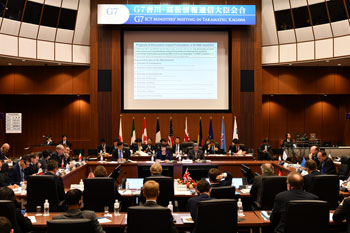
This year Japan is proactively promoting global initiatives for the ICT sector. As one example, Japan served as the host country for the holding of the G7 Ise-Shima Summit, at which it hosted the ICT Ministers’ Meeting as a related ministers meeting in Takamatsu City, Kagawa Prefecture.
Strategy for Global Promotion of ICT
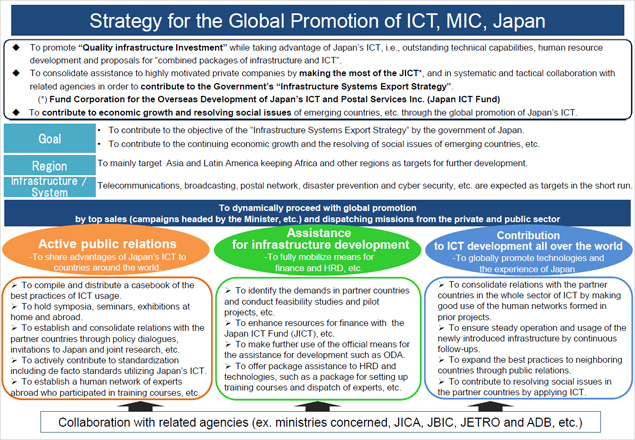
ICT is the basic infrastructure indispensable for the social and economic activities of any country and region. The Ministry of Internal Affairs and communications, one of whose function is the achievement of growth strategies applying ICT, set the “Strategy for Global Promotion of ICT, MIC, Japan” in order to contribute to the global promotion of the infrastructure-related systems in line with the Government’s strategy*.
(*) “Infrastructure Systems Export Strategy, revised” compiled by the Ministerial Meeting on Strategy relating to Infrastructure Exports and Economic Cooperation on June 2, 2015.
Achieving Quality Infrastructure through the ICT of Japan
Japan is willing to contributing to bridging the infrastructure gap, which has become a bottleneck against global economic growth. For this purpose, Japan promotes “quality infrastructure” in collaboration with other countries and international organizations through “Partnership for Quality Infrastructure”.
ICT itself is an infrastructure which is indispensable for the social and economic activities of all the countries and regions. Furthermore, ICT converts usual infrastructures into “Quality Infrastructures” by adding quality-enhancing values such as durability improvement. ICT also enhances disaster management system in swiftness, accuracy and reliability.
The Ministry of Internal Affairs and Communications has collected some of the best practices of the “Quality Infrastructure”, which were achieved with the excellence of the ICT of Japan and the assistance to the capacity building of Japan.
We will be happy if these best practices would be helpful in planning to develop and improve infrastructure in your country and region.
Press for the case book “Achieving Quality Infrastructure through the ICT of Japan”
Playbook for Investment in "Quality ICT Infrastructure"
The Ministry of Internal Affairs and Communications (MIC), Japan formulated a playbook regarding investment in "Quality ICT Infrastructure“ in July 2017, based on the outcomes of the G7 ICT Ministers’ Meeting in Kagawa, Takamatsu in April 2016.
"Quality ICT Infrastructure" may first appear costly. However, since it is easy to use and durable, "Quality ICT Infrastructure" is indeed cost-effective in the long run, contributing to economic development and social problem solving.
By providing the basic concept of "Quality ICT Infrastructure", useful suggestions and best practices to develop "Quality ICT Infrastructure" for ICT policy makers, procurement managers, and personnel in charge of ICT infrastructure, this playbook is expected to increase awareness and needs for “Quality ICT Infrastructure” and to help develop the capacity of ICT infrastructure building.
Overview of the Playbook for Investment in "Quality ICT Infrastructure"
MIC’s contribution to solving social problems all over the world
MIC has implemented many efforts all over the world to contribute to promoting economic growth and to resolving each country’s social problems in various fields such as information and communications technology (ICT), postal systems and related services, firefighting and disaster risk reduction, statistics ICT systems, administrative counseling systems, and administration of local autonomy.
We have formulated “Casebook of MIC’s Collaborations in the World” that shows examples of MIC’s efforts for such contribution among the world.
MIC will continue to contribute solutions for social problems in the world through further efforts.

G7 ICT Ministersʼ Meeting in Takamatsu, Kagawa
The G7 Ise-Shima Summit was held on May 26 and 27, 2016, with Japan serving as the host country for the first time in eight years.
Ten related ministers’ meetings were held for the G7 Ise-Shima Summit, one of which was the G7 ICT Ministers’ Meeting in Takamatsu, Kagawa (held on April 29 and 30). In fact, ministers from the various countries in charge of information and communications technology (ICT) policy have been gathering together at G7 summits since 1995. In that time, the global ICT environment has undergone dramatic changes, such as the Internet, and problems have arisen with issues like cyber security and privacy, while its convenience. Moreover, in recent years new innovations have been created, with these including IoT, big data, and AI. Questions like what should be done to continue to ensure that the benefits of this continuously-developing ICT are shared globally and lead to economic growth and the creation of employment are debated through the framework of the G7, which has led the world on this to date.
In conjunction with this, the hosting of the G7 ICT Ministers’ Meeting in Takamatsu, Kagawa was a rousing success, in that it established an opportunity in which leaders in the ICT field from industry, academia, and the government were invited from within Japan and overseas to hold discussions in a concentrated manner on subjects like ICT-led innovation and economic growth. In addition, it was also an opportunity for Japan to display its world-class, cutting-edge ICT technologies and services.