
March 31, 2026 Outcomes of the Japan-EU ICT Roundtable and the 31st Japan-EU ICT Policy Dialogue
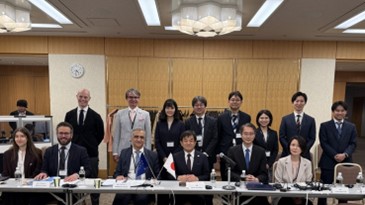
On Friday, March 27, the Ministry of Internal Affairs and Communications hosted the Japan-EU ICT Roundtable and the 31st Japan-EU ICT Policy Dialogue in Tokyo, in collaboration with the European Commission’s Directorate-General for Communications Networks, Content and Technology.
Based on the outcomes of this Roundtable discussion and policy dialogue, we will strive to further deepen and solidify cooperation between Japan and the EU.
1 Japan-EU ICT Roundtable
(1) Overview
This Roundtable serves as a framework to deepen mutual understanding and to promote collaboration and cooperation between the public and private sectors in Japan and the EU on digital policies and initiatives. Representatives from the public and private sectors engaged in a lively exchange of views on a wide range of topics related to the ICT field.
(2) Key Results
A. Beyond 5G/6G
Japan provided an overview of initiatives related to All-Photonics Network (APN), data center decentralization, and other data center-related efforts, as well as recent initiatives, including international joint research between Japan and the EU, and initiatives regarding Open RAN. The EU provided an overview of industry-academia collaboration between Japan and the EU in 6G research and development, as well as the current state of private-sector standardization activities and the future outlook of 6G. Based on the explanations provided by both parties, the importance of promoting further cooperation between Japan and the EU was reaffirmed.
B. AI RAN
Both Japan and the EU discussed the direction of future cooperation and the importance of standardization for network efficiency, reducing operational costs, new revenue models, demonstrating of logistics robot control, and ensuring interoperability, taking into account recent advancements in AI-driven RAN optimization and automation. Through Japan-EU coordination, the importance of establishing an optimal AI execution framework and facilitating a smooth transition was confirmed.
C. Online Platforms (Countering Misinformation and Disinformation)
Japan provided an overview of initiatives undertaken by “Frontria,” an international consortium established in Japan last year to address misinformation, disinformation, and emerging AI-related risks. The EU presented its initiatives, including the Digital Services Act (DSA) and the European Democracy Shield (EUDS), as well as public education programs aimed at improving literacy. Both Japan and the EU also discussed measures to counter misinformation and disinformation, including the possibility of future collaboration.
D. Wireless Charging
Japan provided an overview of its wireless power transmission technology and efforts toward its commercialization and discussed the challenges to its widespread adoption.
E. Quantum
Japan provided an overview of initiatives regarding quantum-secure networks that combine quantum key distribution and post-quantum cryptography, as well as development trends in related technologies such as quantum communication systems and quantum repeaters aimed at realizing a quantum internet. The EU provided an overview of the Japan-EU joint research project “Q-NEKO,” and both Japan and the EU discussed potential areas of cooperation, as well as future challenges regarding safety improvements, international standardization, and ensuring interoperability.
F. Cybersecurity
In response to increasingly sophisticated cyber threats, both Japan and the EU provided an overview of initiatives such as active cyber defense and efforts to ensure supply chain security and discussed the direction of cooperation regarding information sharing and the deepening of international collaboration.
G. Public-Private Partnership
Japan introduced the Fund Corporation for the Overseas Development of Japan's ICT and Postal Services (JICT), a public-private fund that provides risk capital and other support to entities engaged in telecommunications, broadcasting, and postal services overseas.
H. Data Space
Japan presented its data space infrastructure initiative, the “Ouranos Ecosystem.” Both Japan and the EU shared their perspectives on interoperability, governance, and standardization to advance cross-sectoral data integration and discussed the possibility of collaboration and future challenges in achieving safe and seamless data circulation, in line with Japan’s Data Free Flow with Trust (DFFT) initiative.
(Reference) Attendees of the Japan-EU ICT Roundtable
- Japan: Dr. IMAGAWA Takuo, Vice-Minister for International Affairs, Ministry of Internal Affairs and Communications; the National Institute of Information and Communications Technology (NICT); the Fund Corporation for the Overseas Development of Japan's ICT and Postal Services (JICT); and related companies
- EU: Mr. Thomas SKORDAS, Deputy Director-General, Directorate-General for Communications Networks, Content and Technology of the European Commission; and related companies
2 The 31st Japan-EU Policy Dialogue
(1) Overview
This policy dialogue aims to deepen mutual understanding and promote cooperation between Japan and the EU in the field of ICT policies. At this meeting, both sides had lively discussions on each other's latest initiatives regarding important themes in the ICT sector between Japan and the EU.
(2) Key Results
A. 5G・Beyond 5G/6G
Japan explained the Comprehensive Strategy for Digital Overseas Digital Deployment 2030, the rollout of Open RAN in third countries, and the promotion of AI RAN. Additionally, following a review of the progress of the international joint research project on Beyond 5G/6G standardization launched by Japan and the EU last April, both sides discussed their respective initiatives.
B. Quantum
Japan provided an overview of initiatives to build a quantum ecosystem, the Quantum Technology Innovation Hub, research and development of quantum communication technology, and collaboration with Q-STAR. The EU provided an update on the progress of the “EuroQCI” project, which aims to establish a quantum communication network in Europe.
C. AI
Japan explained the reporting framework of the Hiroshima AI Process, the status of the Friends Group and Partners’ Community, and the AI Promotion Act and AI Basic Plan. The EU explained the AI Act, the Code of Conduct, and the AI Safety Institute, among other topics. Both sides then discussed their respective initiatives.
D. Online Platforms
Japan provided an overview of the Act on Establishment of Enhanced Environment for Youth’s Safe and Secure Internet Use, as well as the government’s current initiatives and discussions on the matter and introduced the MIC’ initiative to improve the internet environment for youth. The EU provided an overview of the implementation status of the DSA, efforts to strengthen regulatory frameworks, and youth protection initiatives, including the investigation into Snapchat. Then, the two sides discussed their respective initiatives.
E. Cybersecurity
Japan explained its government-wide initiatives, including the Cyber Response Capability Enhancement Act, as well as the MIC’s efforts to support capacity building through entities such as the ASEAN-Japan Cybersecurity Capacity Building Centre (AJCCBC). The EU provided an overview of its Cyber Resilience Act, initiatives for the security of critical infrastructure and supply chains, and efforts to develop human resources. Then, the two sides discussed their respective initiatives.
F. Digital Infrastructure
Both Japan and the EU reported on the progress of discussions within the Japan-EU Joint Working Group on Policy Issues for Global Connectivity, which was established by mutual agreement last May, and discussed future cooperation.
(Reference) Attendees of the 31st Japan-EU ICT Policy Dialogue
Japanese side: Dr. IMAGAWA Takuo, Vice-Minister for International Affairs, MIC, and others. EU side: Mr. Thomas SKORDAS, Deputy Director-General – DG CNECT of the European Commission, and others.

Contact
For further information about this press release, please fill in the inquiry form and submit it to MIC on the website
https://www.soumu.go.jp/common/english_opinions.html
Global Strategy Bureau, MIC